We’ve all seen the listing: a stunning BMW 5-Series, a sleek Audi A5, or a robust Mercedes M-Class selling for a fraction of its original price. It looks perfect in the photos, the leather is intact, and the paint shines. Then, you look at the odometer: 180,000 km.
Your heart says “yes,” but your brain (and probably your friends) screams “money pit.”
There is a long-standing myth that once a German car hits the 100,000 km mark, it is destined for the scrapyard. But is that actually true? The reality is nuanced. German cars are engineered for the Autobahn; they are designed to cover vast distances at speed. A high-mileage German car can be the bargain of the century—or it can be a financial disaster.
The difference isn’t just luck; it’s about knowing the difference between a car that has been driven and a car that has been neglected. Here is how to tell them apart.
The “German Engineering” Factor
Unlike some economy vehicles designed with a strictly limited lifespan, premium German vehicles (Porsche, Mercedes-Benz, BMW, Audi, VW) use high-quality materials in their engines and drivetrains.
It is not uncommon to see a well-maintained diesel BMW or Mercedes clock over 300,000 km without major engine failure. The core mechanics are robust. However, these cars are technologically complex. The risk usually isn’t the engine block exploding; it is the supporting components—sensors, suspension, and cooling systems—reaching the end of their lifecycle.
Not All Kilometres Are Created Equal
When looking at a high-mileage vehicle, you need to ask: How were these kilometres accumulated?
- Highway KMs (The Good Kind): A car driven 30,000 km a year mostly on highways (like the M1 or Hume Highway) is often in better shape than a low-mileage city car. Highway driving puts minimal stress on the transmission, brakes, and suspension. The fluids circulate at optimal temperatures, keeping the engine clean.
- City KMs (The Hard Kind): A car that has done 80,000 km of stop-start school runs and city commuting has experienced significantly more wear. The constant shifting, braking, and heat cycles degrade components much faster.
Pro Tip: Look at the driver’s seat bolster and the brake pedal rubber. If the car has high kms but these areas look new, it likely lived an easy life on the highway.
Service History: The Non-Negotiable
For a Toyota, missing a scheduled oil change by 5,000 km might be forgivable. For a high-performance Audi or BMW, it is a red flag, especially since their scheduled service intervals are already ridiculously long (we recommend once per year or every 10000-15000km services).
When inspecting the service logbook, look for:
- Consistency: Are the services stamped exactly when required?
- Quality: Was it serviced by a dealer or a European specialist? A generic “quick lube” shop may not use the specific OEM-approved oils required for German engines.
- Transmission Service: Many sellers skip the expensive DSG or automatic transmission fluid flush. If a car has 120,000 km and the transmission fluid has never been changed, walk away or budget for immediate maintenance.
The “Deferred Maintenance” Trap
This is the most common reason high-mileage luxury cars are sold cheaply. The previous owner knows that a major service interval is coming up and trades the car in to avoid the cost.
If you buy a high-mileage car without checking these, you could be hit with a bill for:
-
- Suspension Bushings & Control Arms: German cars are heavy and complex; suspension wears out.
- Cooling Systems: Water pumps and plastic coolant hoses often become brittle after 10 years or 150,000 km.
- Timing Chains: While chains are meant to last, tensioners can fail on certain models, especially if oil changes were neglected.
Why You Need a Specialist Inspection
This is where a general mechanic often fails. They might put the car on a hoist, see no oil leaks, and give it a “pass.”
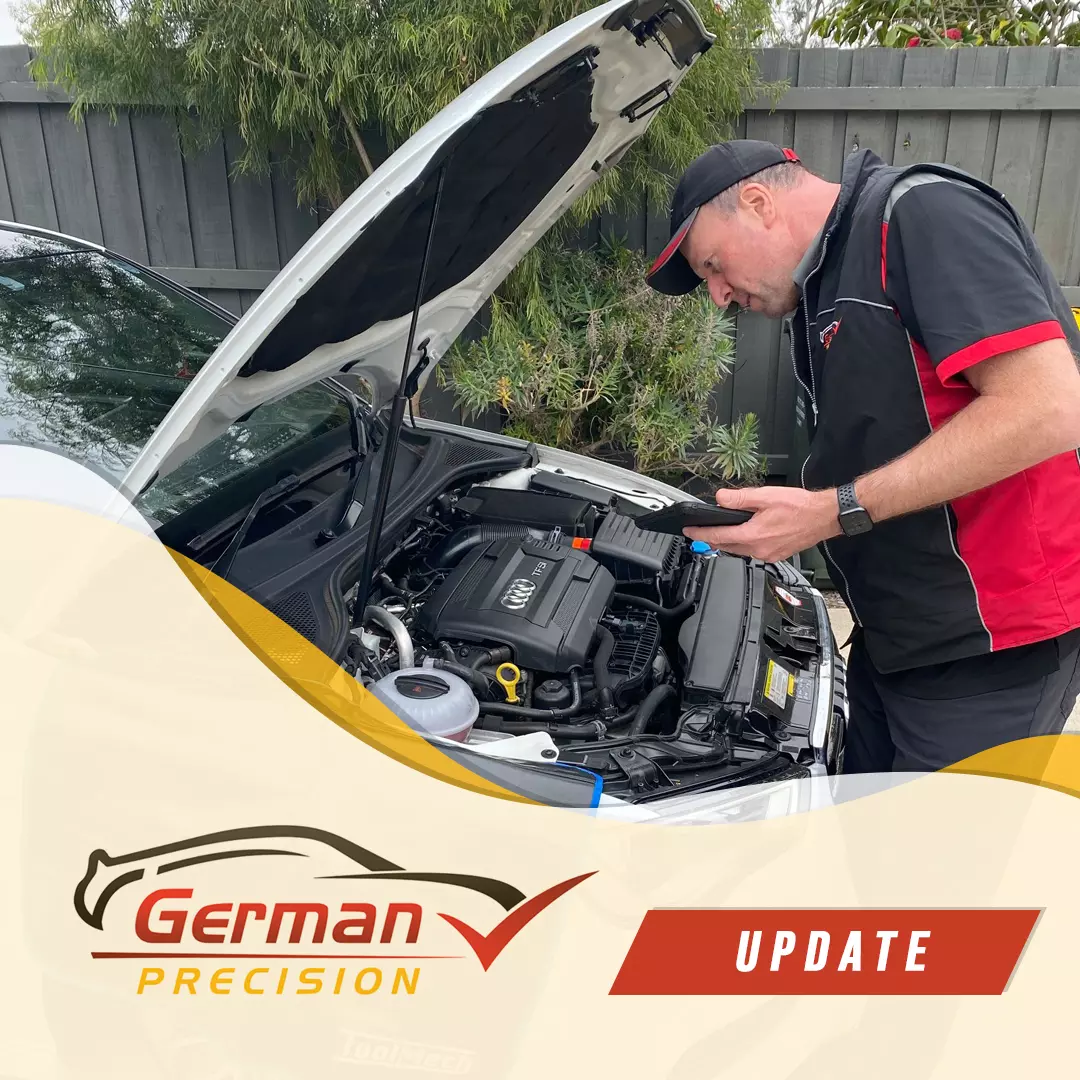
A German Vehicle Specialist knows exactly what to look for on specific models. We know that a faint rattle on a cold start in a Mini Cooper or BMW is a timing chain warning. We know that a slight delay in an Audi’s gear change indicates a Mechatronic unit failure, or shuddering from the DSG may indicate worn dual clutch assembly.
A specialized pre-purchase inspection involves:
-
- Scanning proprietary modules: Reading codes that generic scanners can’t see.
- Testing specific weak points: Checking air suspension bags on Mercedes or turbo wastegates on BMWs.
- Verifying Live Data: checking fuel trim and injector values to assess the engine’s true health.
Verdict: Should You Buy It?
Yes, if:
- It has a complete, specialist service history.
- The interior and bodywork show care (careful owners usually drive carefully).
- You have a pre-purchase inspection report giving it a clean bill of health.
No, if:
-
- The service history has gaps.
- It has mismatched cheap tyres (a sign the owner cut corners on costs).
- You are skipping a professional inspection.
Buy with Eyes Wide Open
A high-mileage German car can offer an incredible driving experience for the price of a used hatchback. But you must buy with your head, not just your heart.
Don’t guess the condition of your next car. At German Precision, we specialize in uncovering the truth about used European (as well as Japanese, Korean, European etc – we apply the same standards to all cars, whether a $200k Bentley, or a $10k Kia) vehicles. We look past the shiny paint to tell you if that high-mileage bargain is a smart buy or a money pit.